
Canada and Australia Look for Common Ground in Impact Investing
Originally published by Sarona Asset Management
Impact investing is growing in both Canada and Australia, yet capital often remains domestic and fragmented. A recent CAFIID webinar brought together organisations from the two countries to examine whether closer collaboration could help.
The conversation was practical. Speakers focused on what is already working, where progress has stalled, and how joint efforts might unlock more capital at home and across neighbouring regions. The session featured speakers from Sarona Asset Management, Australian Impact Investments, Dalberg Advisors and Rally Assets.
What we heard
Australia’s potential sits in its superannuation system
Australia holds the fourth-largest pension system in the world, and the scale of that capital shapes everything that follows. A handful of large funds have begun to make dedicated impact allocations. These commitments remain small, but they signal a shift.
Over the past decade, governments at both federal and state levels have driven the market through social impact bonds, development investment funds, and the creation of vehicles such as the Emerging Markets Impact Investment Fund which has now become the Australian Development Investment trust (EMIIF / ADI).
The challenge is not lack of interest from investors. It is scale. Large institutions invest only when opportunities reach a size that fits their machinery. Philanthropy and family offices can test ideas, but the supply of investable vehicles remains thin. More products need to reach the size that super funds require.
“Australia has the capital and the policy foundations for impact, but the market will not scale until more investable vehicles reach the size that super funds require.”
— Kylie Charlton, Australian Impact Investments (Australia)
Canada shows the effect of structured public–private design
Canada has taken a more centralised path. The federal government created a CAD 755 million Social Finance Fund and selected national wholesalers to seed managers and crowd in private capital. This has sped up market building. Equity considerations are written into mandates, directing capital towards women-led managers, diverse founders and regions that have historically seen little investment, such as the Atlantic provinces, First Nations communities, and Northern Canada.
More capital is now flowing to Indigenous-led fund managers and enterprises as part of a broader effort to integrate reconciliation into investment practice. Canada’s approach shows how design and public finance can reshape who participates in the market and who receives capital.
Measurement works when it stays light
Both markets see impact measurement as essential, though they approach it differently. Australia has built a culture of verification and shared methods, which strengthens credibility but can limit smaller managers. Canada is moving in the same direction but tends to favour flexibility and equity.
Participants agreed that simple tools travel best. A small set of comparable indicators, paired with short outcome narratives, can show real progress without overwhelming organisations. Light assurance helps when investors move across borders. The aim is not perfect data but information that guides decisions.
“Standards matter when they help money move. The goal is not perfect measurement but a shared language that makes cross-border investing possible.”
— Layusa Isa-Odidi, Dalberg (Australia)
Mobilizing private capital requires a portfolio mindset
Canadian firms have found that investors are more comfortable when impact is framed at the portfolio level rather than deal by deal. Some positions offer strong financial returns with moderate impact. Others generate deep social value with different risk and liquidity profiles. Together, they can meet overall targets.
Blended finance can also shift investors behaviour. First-loss and risk-sharing structures have eased the J-curve for Canadian investors and encouraged support for newer funds. These mechanisms matter only when they change decisions, not when they sit unused.
“Impact does not demand a trade-off. The right portfolio structure and the right blend of public and private capital can deliver both returns and equity.”
— Ammara Shirazi, Rally Assets (Canada)
Platforms can link two distant markets
Shared standards help investors speak the same language. Gender-lens frameworks such as the 2X Criteria and blended-finance toolkits offer a base for alignment. Australia’s measurement culture and Canada’s experience with catalytic capital complement each other. The practical opportunity lies in shared due diligence, co-investment and regular exchanges of lessons.
What emerged
Domestic capital tends to stay at home
Investors in both Canada and Australia display a strong preference for domestic assets. Exposure to emerging markets remains limited even when those markets align with climate, gender or development goals. This gap between interest and deployment is a shared constraint. Closing it will require clear structures, trusted intermediaries and early risk from public or philanthropic actors.
Investors need vehicles that match their scale
Institutional investors in both countries back opportunities only when they are large and predictable. Domestic themes such as climate transition and housing remain the easiest fit. For international opportunities, early money from government or foundations can help funds reach first close and make them suitable for larger investors.
Blended finance must be easy to use
Participants stressed that blended finance should be straightforward. First-loss capital, guarantees and similar tools need clear terms and simple templates. Investors also want practical evidence of when these mechanisms have shifted decisions. This keeps the focus on what works.
Key takeaway
Canada and Australia cannot scale impact investing by acting alone. Joint structures, impact measurement and targeted risk-sharing will be needed to move capital at scale. Testing these tools together is now the logical next step.
Invitation
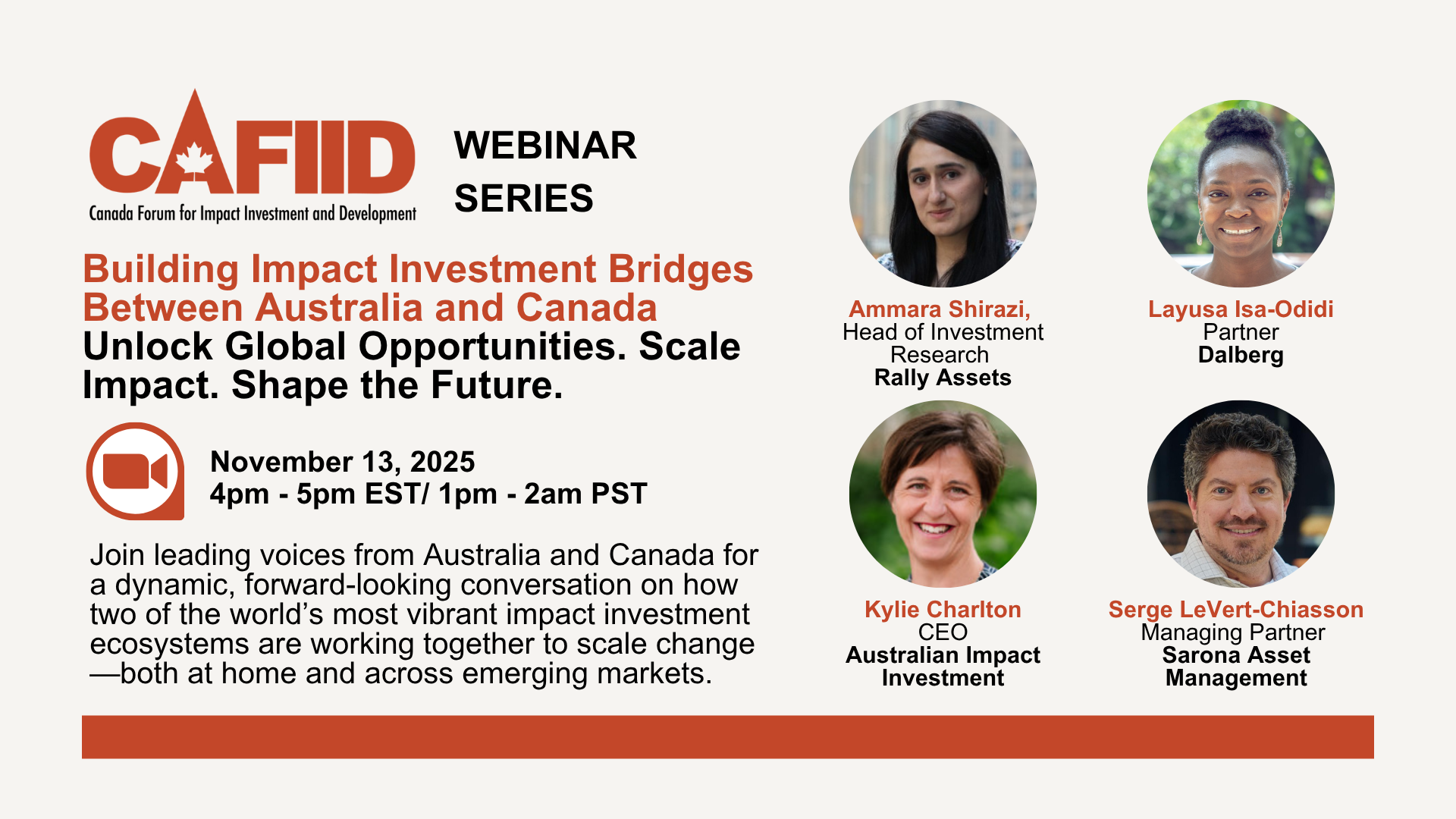
Join leading voices from Australia and Canada for a dynamic, forward-looking conversation on how two of the world’s most vibrant impact investment ecosystems are working together to scale change—both at home and across emerging markets.
In this high-energy webinar, you'll dive into the unique strengths, challenges, and opportunities within the Canadian and Australian impact investing landscapes. Discover how collaboration between these two powerhouse markets can unlock new capital flows, amplify social and environmental outcomes, and drive innovation globally.
Expect candid insights, cross-continental perspectives, and bold ideas as we explore:
What’s working—and what’s not—in domestic impact markets
The surprising similarities (and key differences) in each country’s approach
Strategies for mobilizing capital from the Global North to the Global South
How joint efforts can accelerate progress toward global sustainability goals
Whether you’re an investor, entrepreneur, policymaker, or changemaker, this is your chance to connect with trailblazers and be part of a conversation that could shape the next chapter of global impact.
Featuring
Kylie Charlton, CEO Australian Impact Investment
Ammara Shirazi, Head of Investment Research of Rally Assets / Realise Fund
Layusa Isa-Odidi, Partner Dalberg
Moderator:
Serge LeVert-Chiasson, Managing Partner Sarona Asset Management
Let’s build bridges. Let’s scale impact. Join us.
About the Speakers:
Moderator
Serge LeVert-Chiasson Managing Partner of Sarona Asset Management
Serge LeVert-Chiasson leads the Sarona team, overseeing all business aspects and the compliance program as Chief Compliance Officer. He believes in the role of private businesses in fostering healthy economies. Before joining Sarona in 2009, Serge was VP of MEDA Investments, worked at Export Development Canada and Crédit Lyonnais, and founded Agro Capital Management. He serves on advisory committees, corporate boards, and was the founding chair of the Canada Forum for Impact Investment and Development. Serge holds an MSc in Accounting and Finance from the London School of Economics, an International MBA from the Schulich School of Business, and is a CFA charter holder.
Panel
Kylie Charlton, CEO of Australian Impact Investment
Kylie joined Australian Impact Investments in 2014 and has worked in Australia and internationally at the intersection of mainstream capital markets, impact investment and philanthropy for over 15 years. Kylie is a co-founder of Unitus Capital, Venture Partner for Giant Leap Fund I, Advisor to Giant Leap Fund II, Chair of the Australian Government supported Emerging Markets Impact Investment Fund, member of BetaShares Responsible Investment Committee, advisory board member to the Impact Investment Summit Asia Pacific, and awardee of the AFR 100 Women of Influence 2018. Prior to transitioning her career into impact investment, Kylie spent 11 years in commercial and investment banking. Kylie graduated in Commerce at University of Canberra and has an MBA from the Saïd Business School at the University of Oxford in England.
Ammara Shirazi, Head of Investment Research of Rally Assets / Realise Fund
Ammara has been spearheading our investment research since joining us in 2017, focused oncentring equity within investment decision-making processes. Having developed extensive outbound origination channels, strong relationships with product issuers and highly refined due diligence skills, she leads her team to source and monitor high-quality deals that enable our clients to place their capital in line with their investment goals. Prior to joining Rally, Ammara worked at Grand Challenges Canada and CIBC.
Layusa Isa-Odidi, Partner, Dalberg
Layusa Isa-Odidi is a Partner at Dalberg Advisors, leading the firm’s presence in Australia, working across Asia-Pacific on strategies for private sector engagement in promoting inclusive growth. As a gender and social inclusion practitioner with experience in measurement and evaluation, she brings a multidisciplinary approach to her work. Layusa has long been passionate about the role of the private sector in driving sustainability and thriving economies, spending the earlier years of her career across graduate degrees in international development and business and consulting roles at the Boston Consulting Group and McKinsey & Company. She supports corporates on both core operations (e.g., developing sustainable sourcing strategies targeting female farmers for Mars, Incorporated) and social impact (e.g., translating strategy into metrics and tools for implementation for a leading Indonesian mining company). She has advised UN teams on private sector engagement and World Bank Group teams on the link between social and economic inequalities, such as the impact of gender-based violence on economic participation. Layusa has contributed to designing multiple bilateral programs, ranging from $50 million to $750 million, aimed at catalyzing finance into agriculture, infrastructure, and tourism. She co-led Dalberg’s work on the African Development Bank’s $2 billion agriculture strategy, which similarly sought to catalyze private investment through innovative mechanisms. Additionally, she supported the Global Partnership for Education in developing a financing framework that included innovative mechanisms to facilitate co-investment with DFIs, the private sector, and foundations.